

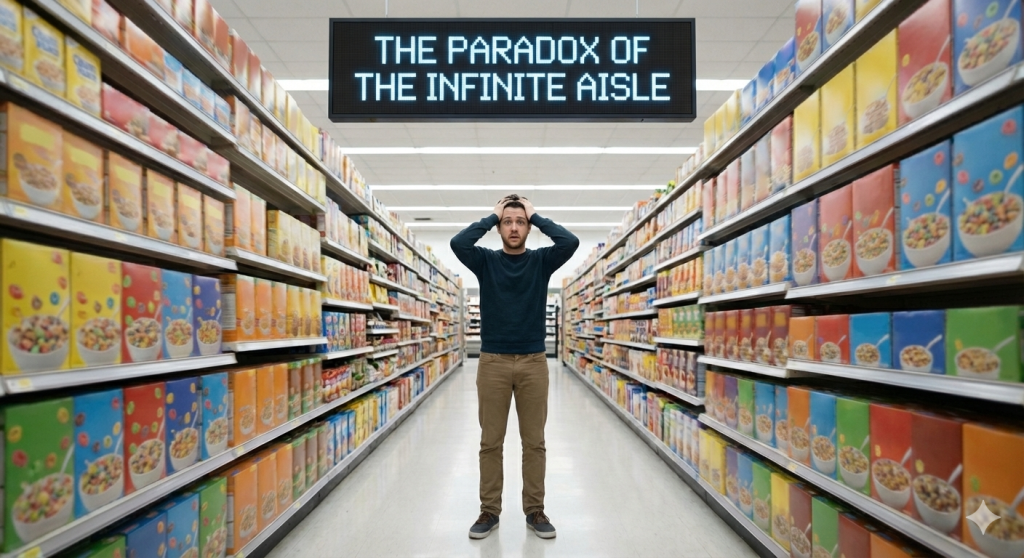
Ever spent forty-five minutes scrolling through Netflix only to give up and stare at the wall in silence? Or stood in the cereal aisle, paralyzed by thirty-four variations of “toasted oats”?
You aren’t indecisive; you’re a victim of Overchoice.
While we’re taught that more options equal more freedom, the reality is often the opposite. Let’s dive into the psychology of choice overload and why your brain sometimes begs for fewer options.
What is Over-choice?
The term was coined by Alvin Toffler in his 1971 classic, Future Shock. He defined a phenomenon that has only become more intense in our digital age:
‘over-choice takes place when the advantages of adversity and individualization are cancelled by the complexity of the buyer’s decision making process”.
-Alvin Tofler
In short, it’s the point where “having it your way” becomes “I can’t deal with this.” When variety exceeds our cognitive limits, it stops being a benefit and starts becoming a barrier.
The Two-Step Decision Dance
According to psychological research, we don’t just “pick” an item. We actually go through a two-stage process to manage the mental load:
| STAGE | GOAL | WHAT WE CRAVE |
| 1. Selecting an assortment | Deciding where to look (e.g which store or website). | Variety. We want to know the options are there. |
| 2. Choosing an option | Picking the specific item within that set. | Simplicity. We want to distinguish the ‘winner’ easily. |
Here’s the catch: Variety is the hero of Stage 1 but the villain of Stage 2. We are attracted to the “huge selection” of a mega-store, but once we’re standing in the aisle, that same variety creates complexity, often leading us to delay the purchase or walk away entirely.
Pictures vs. Words: Hacking Your Brain
How we perceive information determines how overwhelmed we feel. Our brains process visual and verbal data in fundamentally different ways:
1. The Visual Heuristic (The Shortcut)
Images are processed “as a whole.” Because of this, they require less mental heavy lifting. This creates a “visual heuristic”—a mental shortcut that makes us feel like we’re processing information faster than we actually are.
• The Upside: Images make variety feel exciting and manageable.
• The Downside: They can mask the actual complexity of the choice.
2. Verbal Descriptions (The Deep Dive)
Words are processed linearly; your brain strings them together one by one to build meaning.
• The Result: When you are looking at a massive set of choices, verbal descriptions actually decrease perceived complexity. They force the brain to slow down and categorize, making it easier to compare specific features rather than getting lost in a sea of pretty pictures.
How to Beat Choice Paralysis
Whether you are a consumer trying to buy a blender or a business owner trying to sell one, the takeaway is the same: Manage the complexity.
• For Shoppers: If you’re feeling overwhelmed, switch to “List View” or read the specs instead of looking at the photos. It forces your brain to engage its analytical side.
• For Creators: Use images to draw people in (variety), but use clear, structured text to help them finish the job (decision).
Choice is a gift, but only if you have the mental space to open it.
 The Faculty Global
Leave a comment